
Nigel Clarke Wind Orchestra Music Volume 2 – Digital Release!!
THE WIND ORCHESTRA MUSIC OF NIGEL CLARKE VOLUME 2
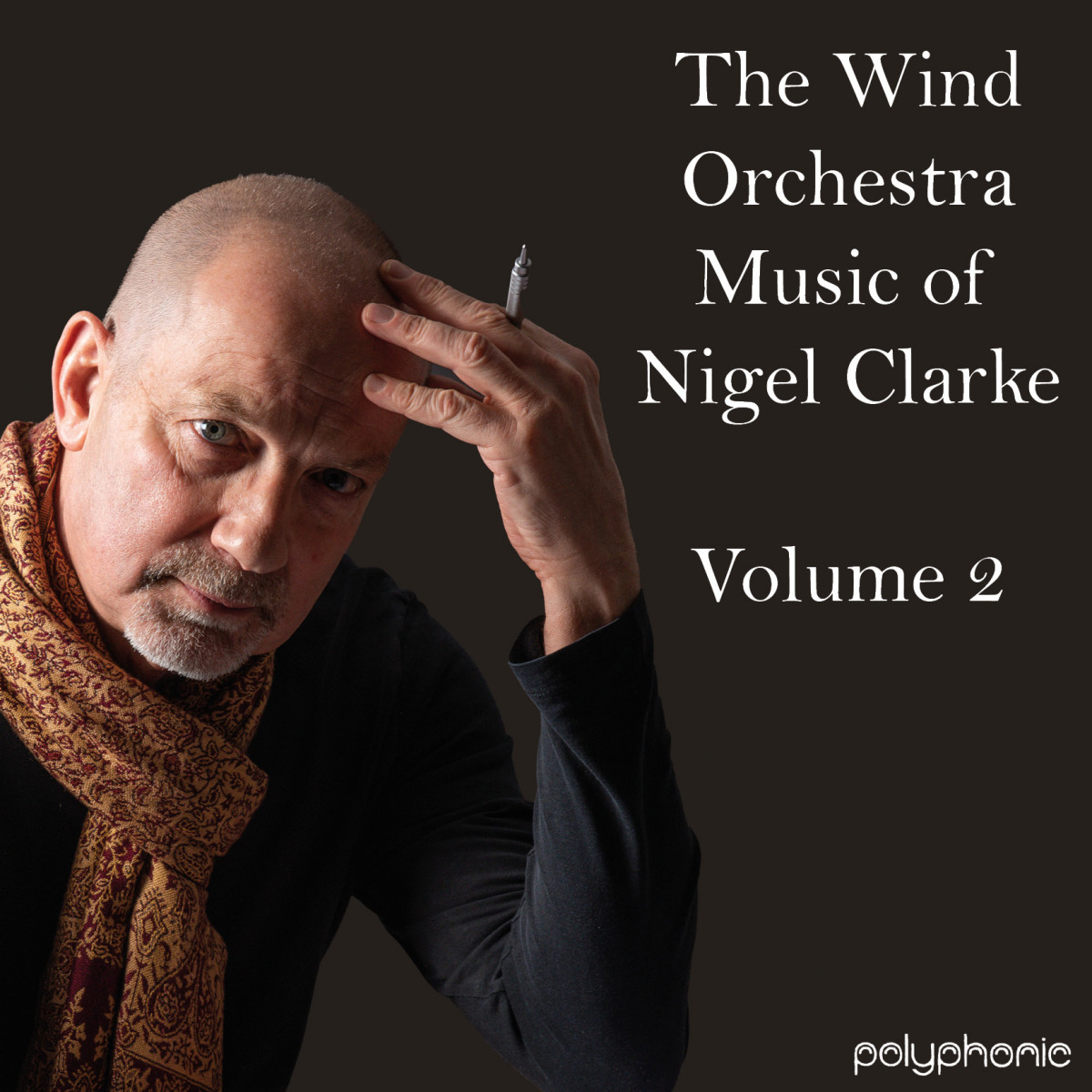 The second of three volumes of Nigel Clarke’s wind orchestra music have been released today (15/08/24) on iTunes and can be downloaded from Amazon Music and streamed on Spotify, Apple Music, ArkivMusic, Youtube Music, Deeper, Tidal and qobuz.
Volume 2 features Tilbury Point, Fanfare & Celebrations, Outrageous Fortune (Symphony for Trombone, Actor & Wind Orchestra), Storm Surge and Their Finest Hour.
Nigel Clarke is known for his bravura orchestration which is especially reflected in his wind orchestra, orchestral and feature film scores. The Naxos record label says of Clarke: “The Brussels-based British composer Nigel Clarke is renowned for his virtuosic style, and an uncompromising contemporary musical language that speaks with an authentic voice to today’s audiences.”
His first wind orchestra work, Samurai, was commissioned by conductor Timothy Reynish and the Royal Northern College of Music Wind Orchestra in 1995 and received its premiere at the World Association of Symphonic Bands and Wind Ensembles (WASBE) Conference at Hamamatsu in Japan. Samurai became an overnight success and since then has beenperformed by the greatest wind orchestras around the world. Clarke has subsequently written many wind orchestra works, and this digital release will be the first volume of three, showcasing Clarke’s contribution to this genre. The recording focuses on some 30 years of Clarke’s musical development and shows the diversity of his musicianship, with each composition having its own unique flavour and style which is distinct from his earlier work. We hope you enjoy this second volume of the wind orchestra music of Nigel Clarke.
Richard Phillips – Head of Music Division, SATCoL
– Sleeve Notes –
TILBURY POINT
Royal Northern College of Music Wind Orchestra / Conductor: James Gourlay
 Tilbury Point was written as a gift to conductor Matthew George and Grand Symphonic Winds, St. Paul in Minnesota, USA after a wonderful evening spent at the Captain Kidd Public House in Wapping London.
Tilbury Point is a short “whiz-bang” overture. Clarke writes: “The idea came about after visiting many of East London’s ancient pubs along the River Thames with the conductor Matthew George. For many centuries these pubs have been home to smugglers, pirates, artists and London’s infamous Execution Dock. Tilbury Point is further down river and is where the pirate Captain Kidd’s body was displayed. His sentence was carried out in 1701 at `Execution Dock’. He was hung, dipped in hot tar to preserve his body and left for three tides to cover his body before being put in a metal cage and taken to Tilbury Point and displayed as a warning to other pirates sailing towards London. This appalling ritual was commonplace during those times!”
The various moods of Tilbury Point are reflected and captured in a specially commissioned poem of the same name by Martin Westlake to accompany this score.
TILBURY POINT
by Martin Westlake
Where the river narrows,
As he sailed, as he sailed,
A marshy spit juts out into the greys.
There once a gibbet stood,
Where Kidd wore the metal hood,
And most wickedly he did, as he swayed.
Around, the waters loop,
As he sailed, as he sailed,
And sweep the vision out to the main.
Where the privateers made sport,
Sending riches to the Court,
And William Kidd made good as he strayed.
A pirate he became,
As he sailed, as he sailed,
When he caught an English captain and his ship.
But French colours on the mast,
Could not efface Kidd’s past
And most wickedly his fate began to tip.
Kidd brained the idiot Moore,
As he sailed, as he sailed,
Sure his British mates would keep him out of court.
But a frightened Boston friend
Guaranteed the Captain’s end;
Prison, madness and fake trials sold him short.
They hanged the Captain twice,
As he wailed and he flailed,
And drowned him fully thrice, as he paled,
His body dangled here,
For the best part of three years,
And most wickedly it did – as he swayed.
Such a sorry way to end,
As he sailed, as he sailed,
Hanged and drowned, tarred and chained, caged and shamed.
Hidden treasure was there none,
Just a poor thief on the run,
A privateer turned pirate falsely blamed.
Where the river narrows,
As he sailed, as he sailed,
Container cranes jut out into the greys.
Swollen tankers ply the docks,
Laden coasters nudge the locks,
And Kidd’s spirit sails unbridled and always.
FANFARES & CELEBRATIONS
Royal Northern College of Music Wind Orchestra / Conductor: James Gourlay
1. Intrada, 2. Processional, 3. Jubilate
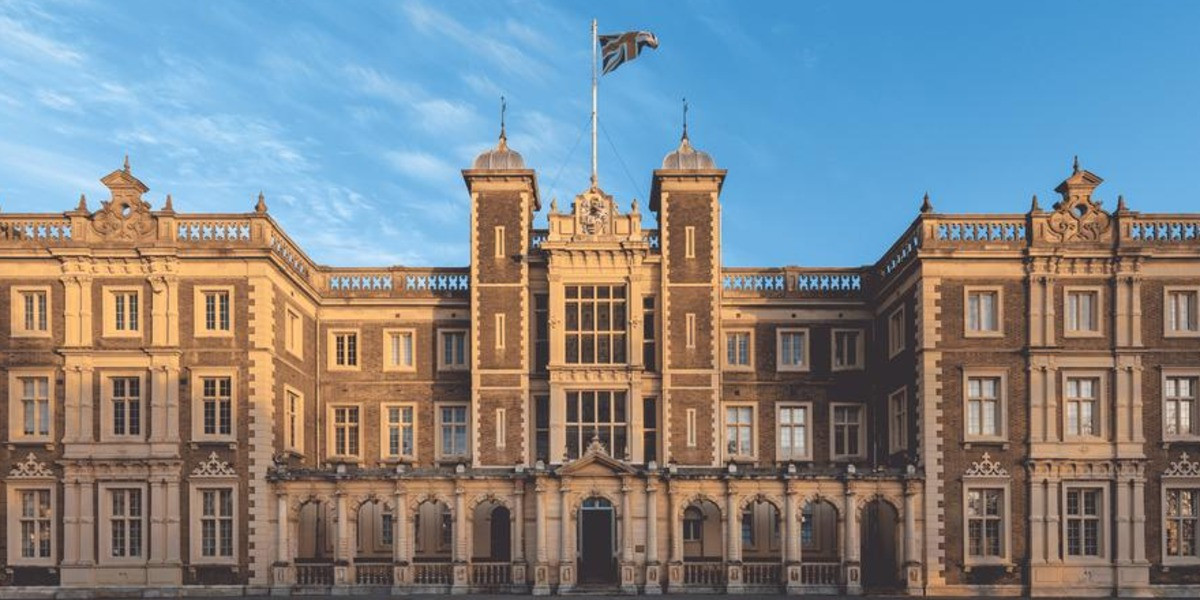 Fanfares & Celebrations was written and commissioned by the Royal Military School of Music, Kneller Hall to celebrate the school’s 150th anniversary. The Royal Military School of Music was formed in 1857 by Field Marshal H.R.H. The Duke of Cambridge who was the professional head of the British Army. Music had been a part of army life since 1685 when one of the first regimental bands was formed, the “First or Grenadier Regiment of Foot Guards”. The decision to create an army music training establishment was taken during preparations for Queen Victoria’s review of 16,000 soldiers, including her regimental bands, in 1854 at Scutari. It was not until these mass bands attempted to play the National Anthem that disaster struck. The bands had no history of playing ‘en masse’ which resulted in a rendition in different tempos played in a cacophony of different keys! After this embarrassment, H.R.H. The Duke of Cambridge elected to ensure that this would never happen again. He acquired the house and grounds of Kneller Hall (built in 1709), the former residence of the court painter Sir Godfrey Kneller in Twickenham, and set up the Royal Military School of Music (R.M.S.M). Over the last 150 years R.M.S.M. has trained many outstanding military musicians and is now also the headquarters of the Corps of Army Music. Clarke himself as a young musician studied there for a year in 1979 and was the school’s first Associate Composer.
Fanfares & Celebrations is written in three movements. Intrada, Processionnal and Jubilate. All three movements are held together by the opening unison fanfare on the brass. Clarke has used many quotations and half quotations throughout the work to represent the R.M.S.M’s history; some are obvious, like the world famous tune to `British Grenadiers’ which he has used to represent the British Army, and some are less so! Clarke also uses fragments from the folk tune `Blow Away the Morning Dew’ which is the R.M.S.M march.
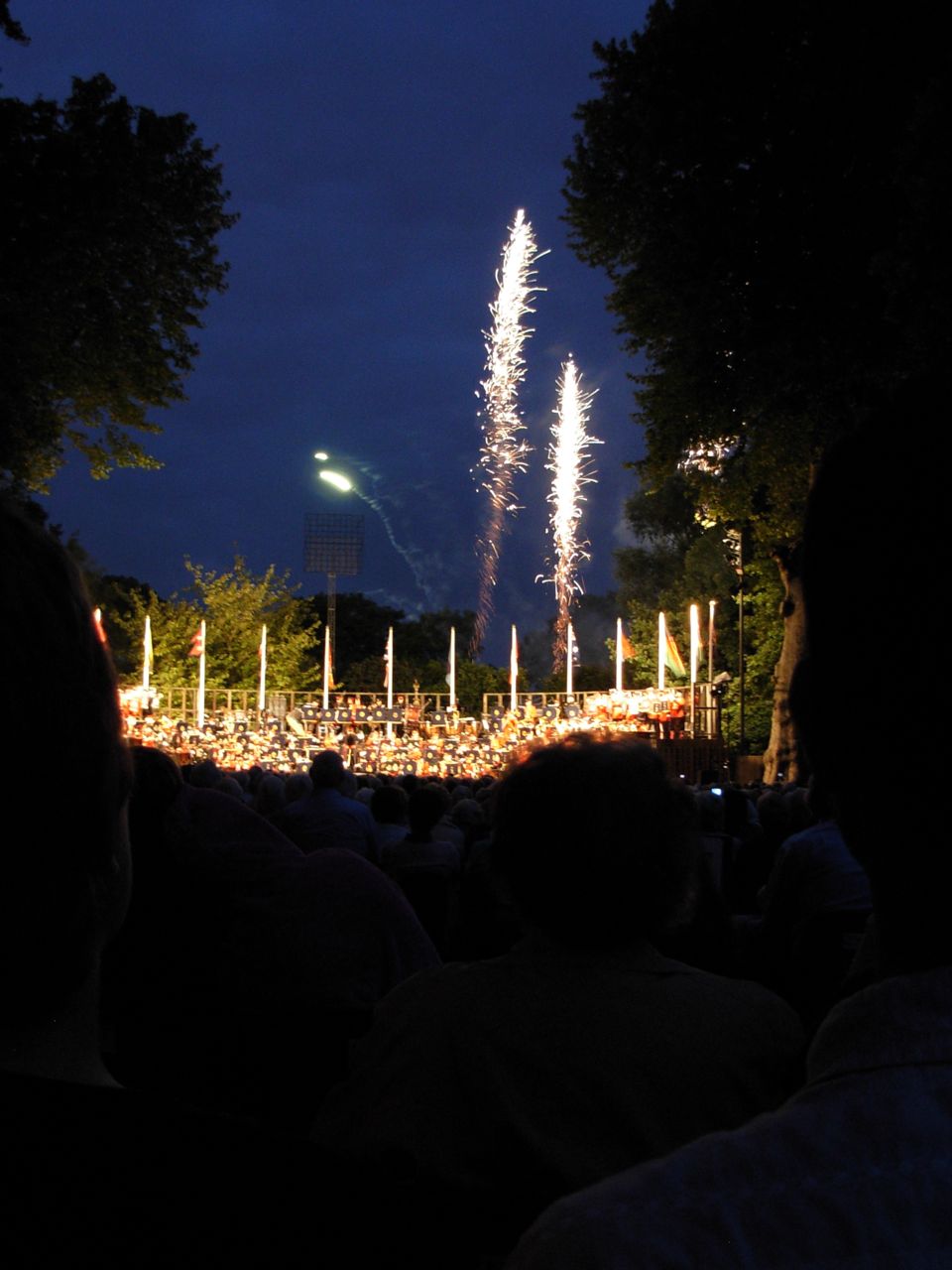
The premiere of `Fanfares & Celebrations’ written to celebrate the 150th anniversary of the Royal Military School of Music (Kneller Hall). Nigel’s work was accompanied by fireworks.
Clarke has written Intrada’ in the style of a short overture that is heroic in flavour. On occasions there are interruptions and references to `God Save the Queen’, reminding us of the cacophony at Scutari. In the latter half of this movement there is an arrangement of `The British Grenadiers’ which is ultimately played at the same time and in competition with his opening fanfare.
Processional is a slow and stately dance that pays tribute to Sir Malcolm Arnold, who died as Clarke started writing this movement. Sir Malcolm wrote a number of pieces dedicated to R.M.S.M including his `H.R.H The Duke of Cambridge March’, which was composed for the School’s centenary. Embedded in the Processional are the famous `Westminster Chimes’ signifying the Corps of Army Music’s involvement in British state occasions including the `State opening of Parliament’. Before the movement ends, listen out for a well-known foreign tune in the background! Clarke brings the movement to a close with a short extract from the `Last post’, quietly heralded by muted brass.
`Jubilate’ is the final movement of this musical celebration. After a loud and furious percussion display a jocular variation of the opening fanfare is heard. Fanfares & Celebrations finally reaches its climax with a potpourri of British Army bugle calls that include `Retreat & Sunset’, `Royal Salute’, `Fall In’, `Men’s Meal’, `Band’, and `Salutes for Royalty/Viceroy’. This musical collage leads to the final rendition of Clarke’s original fanfare which brings the work to its triumphant, optimistic close.
The premiere was given by the Corps of Army Music made up of representatives of the Regimental Band of Her Majesty’s Grenadier Guards, the Band and Bugles of the Rifles and the Band of the Royal Signals conducted by Lt.Col Stephen Smith, Principal Director of Music Army, at Kneller Hall on 1 August 2007.
OUTRAGEOUS FORTUNE
A Symphony for Trombone Soloist, Actor and Wind Orchestra
Royal Northern College of Music Wind Orchestra, Brett Baker (Trombone), Natalie Grady (Actor) Conductor: Reed Thomas
Outrageous Fortune – Symphony For Trombone Soloist, Actor & Symphonic Wind Orchestra is written and dedicated to Brett Baker, Natalie Grady, Reed Thomas and the Middle Tennessee State University Wind Ensemble. It was premiered on 15 September 2016 by the MTSU Wind Ensemble, Brett Baker (Trombone), Nigel Clarke (Actor), and Reed Thomas (Conductor) in the T. Earl Music Hall, Wright Building, Murfreesboro, Tennessee, USA.
 Clarke wrote Outrageous Fortune as a symphonic drama rather than in the structure and sentiment of a traditional concerto. He has taken this approach from Hector Berlioz’s masterpiece Harold in Italy, symphony with viola obbligato which illustrates how a soloist can be part of a larger symphonic work.
Clarke has designed Outrageous Fortune as a melancholic drama, bleak and sardonic in style. It follows programmatically the story of the Shakespearean tragedy Hamlet. The score is prefaced with the Bard’s despairing words:
“Thus bad begins, and worse remains behind”
Hamlet is a tale of conspiracy, betrayal, suicide, revenge and murder, and also a ghost story. Both the trombone soloist and the actor take on the role of Hamlet, the Prince of Denmark. Outrageous Fortune reflects the protagonist’s despair, his self-doubt and self-loathing and his advance towards mental breakdown. Hamlet’s character is full of bitterness, but alongside this he shows profound wisdom beyond his years. Clarke has set to music two of Hamlet’s soliloquies:
“O that this too too sullied flesh would melt”
and
“To be, or not to be, – that is the question”
 Hamlet’s first monologue sees him longing to be dead and contemplating his own suicide although he is concerned that the Almighty has forbidden this option by sacred law. The cause of Hamlet’s malady is his distress that his mother has just remarried following the death of his father (the former King) less than two months ago. His mother’s suitor is his father’s own brother, Hamlet’s uncle. Hamlet denounces the rashness of his mother’s actions without apparent concern for his father’s death:
“She married. O most wicked speed, to post
With such dexterity to incestuous sheets!”.
The second soliloquy “To be, or not to be, – that is the question” finds Hamlet near to mental breakdown, grappling with the choice between killing himself, or living on to avenge his father’s murder. However, he is reluctant – who knows what suffering awaits him after death?
“But that the dread of something after death,
The undiscovered country, from whose bourn
No traveller returns – puzzles the will,
And makes us rather bear those ills we have,
Than fly to others that we know not of.
Thus conscience does make cowards of us all”
 Clarke has selected various lines of dialogue from Shakespeare’s tragedy to help give the symphony structure and a sense of continuous and cohesive narrative throughout. These fifteen lines also serve as scene titles in the score, outlining the unfolding drama. Solo soliloquies recited by the actor are found at the beginning and in the middle of the work. The trombone is the voice of Hamlet and represents both his inner thoughts and outward actions. The trombone soloist is in an accompanying role during the actor’s rendition of `To be or not be’. This section is in effect a cadenza for both actor and trombone, with the trombone weaving in and out of Shakespeare’s immortal lines. The dialogues chosen from Shakespeare’s drama are highly descriptive, lending themselves particularly well to music-setting – for instance: `The kettledrum and trumpet thus bray out’ or `The rest is silence’. Outrageous Fortuneis a ‘birth to death’ piece – it grows from nothing, in this case a quiet and ominous atmosphere, to end in decay, despair and deathly silence.
Outrageous Fortune scene-titles:
`O that this too too solid flesh would melt’
`Something is rotten in the state of Denmark’
`The kettledrum and trumpet thus bray out’
`Alas, poor ghost’
`Revenge his foul and most unnatural murder!’
`To be or not be’
`Get thee to a nunnery’
`The Mousetrap’
`What warlike noise is this’
`The King’s Jester’
`Revenge should have no bounds’
`Unbated and envenomed’
`Rapier and Danger’
`Now crack a noble heart’
`The rest is silence’
Text 1. “O that this too too solid flesh would melt”
O that this too too solid flesh would melt,
Thaw, and resolve itself into dew,
Or that the Everlasting had not fixed
His canon ‘gainst self-slaughter. O God, God!
How weary, stale, flat, and unprofitable
Seems to me all the uses of this world!
Fie on’t! ah, fie!, ’tis an unweeded garden
That grows to seed: things rank and gross in nature
Process it merely. That it should come to this!
But two months dead – nay, not so much, not two –
So excellent a king, that was to this
Hyperion to a satyr, so loving to my mother
That he might not beteem the winds of heaven
Visit her face too roughly. O Heaven and earth,
Must I remember? Why, she would hang on him
As if increase of appetite had grown
By what it fed on. And yet within a month!
Let me not think on’t – Frailty, thy name is Woman.
A little month, or e’re those shoes were old
With which she followed my poor father’s body,
Like Niobe, all tears. Why, she, even she –
O God, a beast that wants discourse of reason
Would have mourned longer! married with mine uncle,
My father’s brother but no more like my father
Than I to Hercules. Within a month!
Ere yet the salt of most unrighteous tears
Had left the flushing of her galled eyes,
She married. O most wicked speed, to post
With such dexterity to incestuous sheets!
It is not, nor it cannot come to good.
But break, my heart, or I must hold my tongue!
Text 2. “To be, or not to be – that is the question”
To be, or not to be – that is the question.
Whether ’tis nobler in the mind to suffer
The slings and arrows of outrageous fortune,
Or to take arms against a sea of troubles,
And by opposing end them. To die: to sleep –
No more; and by a sleep, to say we end
The heartache, and the thousand natural shocks
That flesh is heir to? ‘Tis a consummation
Devoutly to be wished. To die: to sleep –
To sleep: perchance to dream. Aye, there’s the rub,
For in that sleep of death what dreams may come,
When we have shuffled off this mortal coil
Must give us pause. There’s the respect
That makes Calamity of so long life.
For who would bear the whips and scorns of time,
The oppressor’s wrong, the proud man’s contumely,
The pangs of despised love, the law’s delay,
The insolence of office, and the spurns
STORM SURGE
Poem by Martin Westlake
Royal Northern College of Music Wind Orchestra, Narrator: Benjamin K. Lewis, Conductor: Clarke Rundell
Storm Surge was commissioned by the Marinierskapel der Koninklijke Marine (Marine Band of the Royal Netherlands Navy) and is dedicated to their Director of Music, Major Peter Kleine Schaars and the band. The first performance was given in De Doelen, Rotterdam, the Netherlands, on 6th November 2013.
Storm Surge is a musical representation of the devastating North Sea storm surge (in Dutch,Watersnoodramp) of 1953. The surge left 2,551 dead – 1,836 from the Netherlands alone, together with fatalities in Scotland, England and West Flanders in Belgium. Nine percent of farmland in the Netherlands was flooded, over 30,000 animals were drowned and tens of thousands of properties were damaged or destroyed. The destruction was certainly comparable to that caused by Hurricane Katrina in 2005 which caused 1,833 fatalities in the southern United States of America and the Caribbean as well as Eastern North America. In today’s world we increasingly reassure ourselves that that we control our environment but the truth is that we are not, and never will be, immune from the forces that nature can unleash upon us.
The storm of 1953 began during the night of 31 January and continued through the morning of 1 February. The devastating event resulted from a combination of a high spring tide, heavy wind and rain and a massive storm over the North Sea. Following on from this catastrophe, the Netherlands built a formidable system of storm surge barriers known collectively as the `Delta Works’. The American Society of Civil Engineers named this engineering feat to be one of the Seven Wonders of the Modern World.
In my musical depiction, Storm Surge starts off with calm waters while we hear the steadily growing sounds of the wind and the sea. A specially commissioned poem written by Martin Westlake and spoken over these sounds warns of the dangers of ignoring the storm. An off-stage trumpet is heard playing a fragment from `Wilhelmus van Nassouwe’ – the National Anthem of the Netherlands. Slowly, the storm starts to take hold and the sea begins to swell. The violence of the storm then erupts but before it reaches its climax the music returns briefly to the Dutch National Anthem giving a sense of the calm in the `eye of the storm’. Then it returns to the storm surge and depicts the sea breaking through and ravaging the coastline. Eventually the storm-surge recedes until a lone trumpet is left quoting broken fragments of `Wilhelmus van Nassouwe’ – the piece closes with a calm breeze mournfully revealing the devastation left behind by this natural disaster.
Storm Surge
By Martin Westlake
Now hear this, ye denizens of false land;
Beware the heaving back of the sleeping giant!
Yay, you may tame and train docile waters,
Build your dykes and your levees,
Channel the flows and gutter the rains.
But when the oceans stir,
When the winds and the tide and the cloudbursts combine,
When the waters mass and the storms drive shoreward,
Then you will learn a terrible truth.
For there is no such thing as a level sea,
Only the inexorable surge of the storm tide,
Wave after wave, slurping at your crumbling defences,
Nibbling at the chinks, pouring through the breaches,
Swirling through and down, washing away homes and souls,
Swamping, drowning, engulfing pasts and futures,
And only then receding, slowly, to reveal soaked and shattered ruins.
Oh ye of faith or of no faith, remember this;
No man may rebuke the winds and the sea;
No man may still the storm.
THEIR FINEST HOUR
(A Portrait Overture)
Royal Northern College of Music Wind Orchestra / Conductor: Mark Heron
 `Their Finest Hour’ was commissioned by Wing Commander Duncan Stubbs BA FRSM ARCM LGSM RAF and the Central Band of the Royal Air Force to celebrate the 70th Anniversary of the Battle of Britain. The premiere was given by the Central Band of the Royal Air Force under the baton of Wing Commander Duncan Stubbs on 1 October 2010 at RAF Northolt and broadcast on BBC Radio 2 as part of the BBC `Friday Nights Is Music Night’ tribute concert to `The Few’. The USA premiere was given by Middle Tennessee State University Wind Ensemble conducted by Lindsay Seagroves on 18 November 2010 in the T. Earl Hinton Music Hall, Wright Music Building, Murfreesboro, Tennessee.
The title of the work is taken from a speech delivered by Prime Minister Winston Churchill on 18 June 1940, within which he famously spoke the words “This was their finest hour”. Allied pilots in the Battle of Britain known as the `The Few’ numbered 2,353 British and 574 from overseas. The allied pilots that fought in this great aerial battle were a coalition of British, Polish, New Zealand, Canadian, Czechoslovakian, Australian, Belgian, South African, French, Irish, American, Jamaican, Palestinian and Rhodesian nationals. The battle was fought over Britain between 10 July and 31 October and saw 544 lives lost, with a further 791 lost bythe end of the war.
`Their Finest Hour’ starts with a section subtitled `Scramble’ – an alarm is sounded on the airfield for the fighter pilots to scramble to their planes. The snare drum represents the sound of engines coughing and spluttering into action followed by the unmistakable roar of Supermarine Spitfire and Hawker Hurricane engines.
The next short section, entitled `This Was Their Finest Hour’, is nostalgic and lyrical in nature. The mood of this patriotic music is broken by a short battle sequence `Bandits, one o’clock!’ Soon the aerial skirmish subsides and is followed by `Victory & Flypast’, which builds on the nostalgic melody heard earlier, and brings the piece to a triumphant close.
Their Finest Hour
by Martin Westlake
Our finest, there;
Scrambling
Across history books,
Penning foreign names,
Great loops and swoops
In the blue void,
Floating and fighting,
Fleeing and flailing,
Dotted fuselages
Flaming earthwards
To young deaths
Vengeful brothers,
Stalking and chasing,
Spitting justice,
Howling menace,
Never flinching,
Steadily gaining,
Until fiercely triumphant
In this, Their finest hour
NIGEL CLARKE(Composer)
 NIGEL CLARKE (b.1960) The British composer Nigel Clarke grew up in the seaside town of Margate, UK and though not from a musical family, developed a lifelong love of music at an early age while learning a brass instrument at school. At 16 he joined the Royal Marines as a junior military bandsman and went on to serve in the Band of the Royal Army Medical Corps and ultimately the Band of the Irish Guards. His desire to write music was encouraged at the Royal Military School of Music, Kneller Hall. This led him study composition at the Royal Academy of Music, London with Paul Patterson.
During his professional career Clarke has held posts as Composition and Contemporary Music tutor at the Royal Academy of Music, and Head of Composition at the London College of Music and Media. His many national and international residencies and associations include positions with the Young Concert Artist Trust, The Hong Kong Academy for Performing Arts, Black Dyke Band, Brassband Buizingen, Grimethorpe Colliery Band and Middle Tennessee State University. Clarke’s longest musical collaboration has been with violinist Peter Sheppard Skærved.
Clarke’s scores include works for symphony orchestra, brass, wind, and chamber combinations, and he has also been nominated for numerous awards for his compositions for the concert hall and for film. His works are recorded on many prestigious labels and are performed worldwide.
ROYAL NORTHERN COLLEGE OF MUSIC WIND ORCHESTRA
The RNCM Wind Orchestra is one of several large-scale ensembles that make up the wide diversity of music-making at one of the world’s leading music conservatoires. In 2000, the RNCM was awarded a second Queen’s Anniversary Prize for Higher and Further Education in recognition of its ‘outstanding education work’. The citation reads: “Through a unique series of commissions, broadcasts, professional recordings, and world-wide performances by its staff and students, the College has transformed the repertoire and performance standards of wind ensemble music in this country. Its outstanding achievements in this field have brought international acclaim.”
BRETT BAKER (Trombone)
 Brett Baker is viewed internationally as a leading brass performer and educator. He is passionate about encouraging composers to write pioneering new repertoire having commissioned over 100 trombone solos, and is one of the most recorded brass soloists. Brett was Programme Leader for Musical Arts (previously band musicianship) at the University of Salford for seven years. He continues to be an Artist for Michael Rath Brass Instruments and is long serving Principal Trombone of the Black Dyke Band. Recently he became Marketing Lead & Global Artist Liaison for Denis Wick Products and Vice Chair of the Association of Brass Band Adjudicators.
As well as a performance schedule of 40 concerts a year, Brett enjoys presenting workshops, specialising in solo performance and band training. Brett has performed on over 30 solo albums, 8 under his own label of White River Evocations, which produces and distributes CDs. He has performed as guest soloist on a further 40 CDs. He regularly tours in the USA, Europe, Australia and New Zealand as a soloist, teacher, conductor and adjudicator. As a consultant, Brett, has worked with Michael Rath Musical Instruments for over 18 years on instrument design and has assisted in the production of a signature mouthpiece. He was taught by Robert Morgan, Lyndon Baglin, Steve Walkley, Christopher Houlding, Kevin Price and Denis Wick.
As a conductor, Brett has many associations with bands in the North of England, and has achieved contest successes with Northop, Ratby and Longridge bands. He has been guest conductor of the University of Salford Brass Band, the brass band at the Royal Northern College of Music, thew National Youth band of Scotland, the European Youth Brass Band, Thoresby Colliery, Carlton Main Frickley Colliery and the Leyland Band.
In 2014 Brett conducted Tongwynlais Temperance at the National Finals of Great Britain in the Royal Albert Hall, London. Brett was conductor of the University of Salford Symphonic Wind Band from 2014-2019. He is currently Musical Director and tutor of both the Yorkshire Youth Brass Band and the North-East Midlands Youth Brass Band and has conducted the massed ensemble at Trombonanza in Argentina.
As an adjudicator, Brett, has judged regularly, the International Trombone Association in the USA, the National Solo Championships in Switzerland, many Association contests, the Scottish Open, Butlins Mineworkers Festival, the National Finals in the Netherlands, Lithuania, New Zealand and Australia. He has judged all the regional area qualifiers for the National Championships of Great Britain and many solo contests worldwide.
He has been trombone tutor of the National Youth Brass Band of Scotland, the National Youth Band of Wales, National Youth and Children’s Brass Band of Great Britain, the European Youth Brass Band, the International Brass Band Summer School in Swansea as well as low brass tutor of the International Summer School in Dartington, Devon.
In 2020 Brett won the ITA Presidents Award for Solo Performance and services to the International Trombone Association and has been featured regularly as a soloist with the Association, including in Salt Lake City, Utah in 2023.
BENJAMIN K. LEWIS (Narrator)
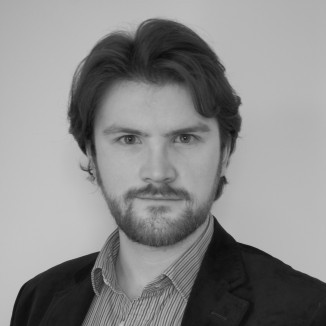 Multi-award-winning Benjamin Lewis is a baritone and recitalist who began singing as a founding member of the Hallé Youth Choir and student of Patrick McGuigan. Currently tutored by Nicholas Powell, his roles have included Buonafede (Il Mondo della Luna), Peter (Hansel and Gretel), Sharpless (Madama Butterfly), Il Conte (Le nozze di Figaro), and Count Harasova (The Jacobin) while in the 2014 Buxton Festival Chorus. Benjamin has appeared in three RNCM operas, as Boris (Paradise Moscow), Belcore (L’elisir d’amore), and Danilo (The Merry Widow). While at the RNCM he also took roles in opera scenes including Owen (Owen Wingrave), Sid (Albert Herring), Cecil (Gloriana), Rigoletto, Il Poeta (Il Turco in Italia) and Lescaut (Manon). In 2015 Benjamin was a member of the Glyndebourne chorus, and in 2016 will cover the title role in Eugene Onegin for Garsington Opera while being a member of the chorus and singing the Trojan (Idomeneo). In 2016/17 he joined the National Opera Studio as a trainee.
NATALIE GRADY (Actress)
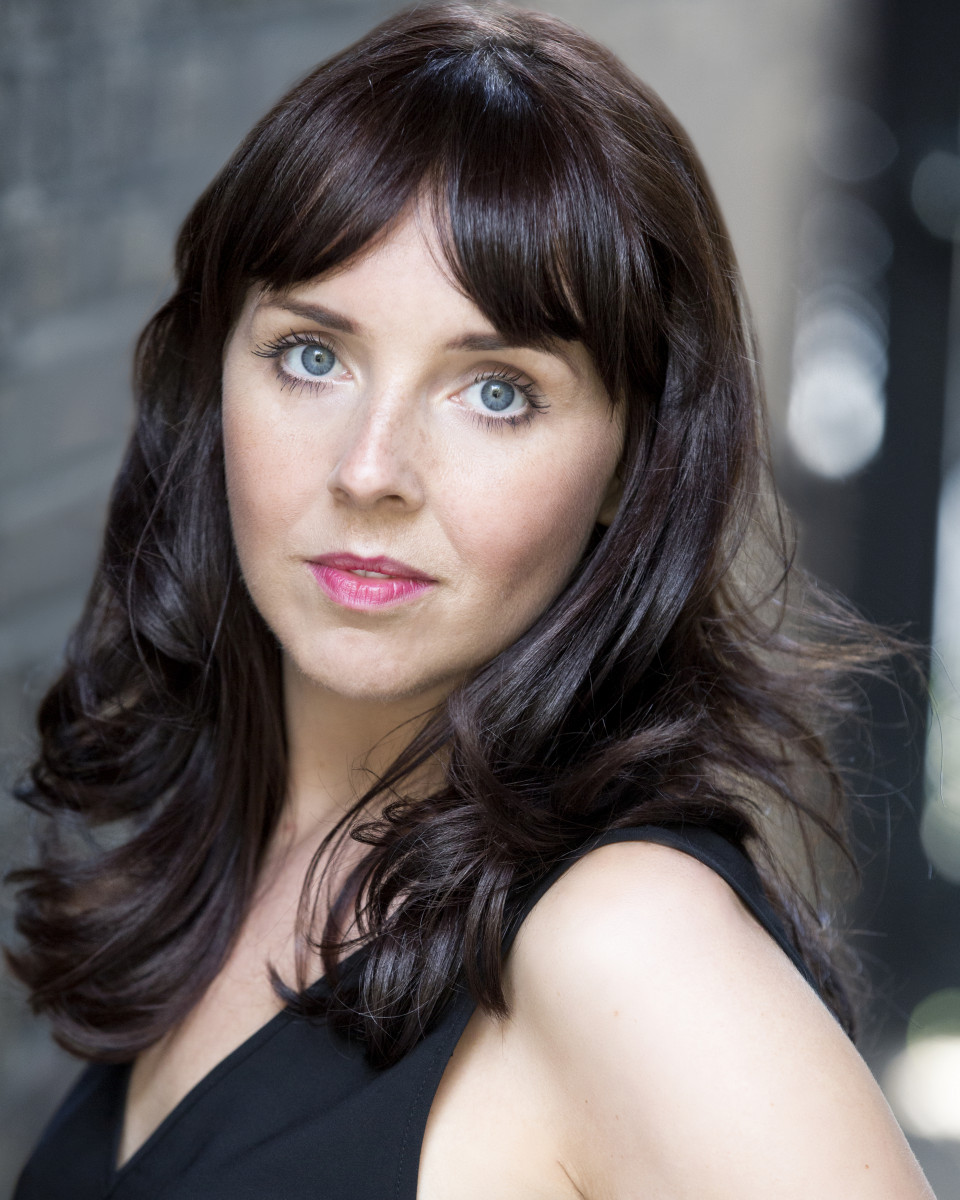 Natalie Grady trained at the Drama Centre London. Alongside her work as an actor, she is also a professional dialect coach. Her theatre credits include J. M. Barrie’s Peter Pan (Park Theatre, London); Brecht’s Mother Courage (Library Theatre, Manchester); Harold Brighouse’s Hobson’s Choice; Davenant’s The Wits (Shakespeare’s Globe, London); Mark Herman’s Brassed Off (Oldham Coliseum); Charlotte Jones’ Martha, Josie and the Chinese Elvis (Octagon/Hull Truck); Philip King’s See How They Run (West End and tour); Ayub Khan Din’s Rafta Rafta (National Theatre, London); D. H. Lawrence’s The Daughter in Law (Library Theatre, Manchester); Harper Lee’s To Kill a Mockingbird (Regent’s Park/Barbican, London); Christopher Sergel’s Galithea (Shakespeare’s Globe); Glyn Maxwell’s Merlin and the Woods of Time (Grosvenor Park, Chester); Tom MortonSmith’s In Doggerland (Box of Tricks, Manchester); Joe Orton’s What the Butler Saw (Salisbury Playhouse); Shakespeare’s A Midsummer Night’s Dream and Julius Caesar (Storyhouse, Chester); Twelfth Night (Octagon) and As You Like It (Grosvenor Park and the Sheffield Crucible/RSC); and Wilde’s The Importance of Being Earnest (Library Theatre). Her television credits include Snatch (Sony/Crackle), Trollied (Sky 1), Coronation Street and Endeavour (ITV), and Doctors, Jam and Jerusalem and Six Wives (BBC). Her radio credits, all for BBC Radio 4, include Brief Lives, Dead Man’s Suit, The Dogs and the Wolves, The Flea, Higher, His Father’s Wife, IOU, Loneliness of the Long Distance Runner, Love, War and Trains, Saturday Night and Sunday 15 Morning, Silver Street, That’ll be the Day and The Trial. She has won a number of distinctions in the Manchester Theatre Awards: Best Supporting Actress in 2012 and nominations for Best Actress in 2014 and Best Supporting Actress in 2016.
REED THOMAS (Conductor)
Reed Thomas is the Director of Bands and Professor of Music and Conducting at Middle Tennessee State University. His responsibilities include conducting the Wind Ensemble and University Chamber Winds, teaching undergraduate courses in conducting and instrumental methods, graduate courses in conducting and wind and orchestral repertoire, and he guides all aspects of MTSU band program.
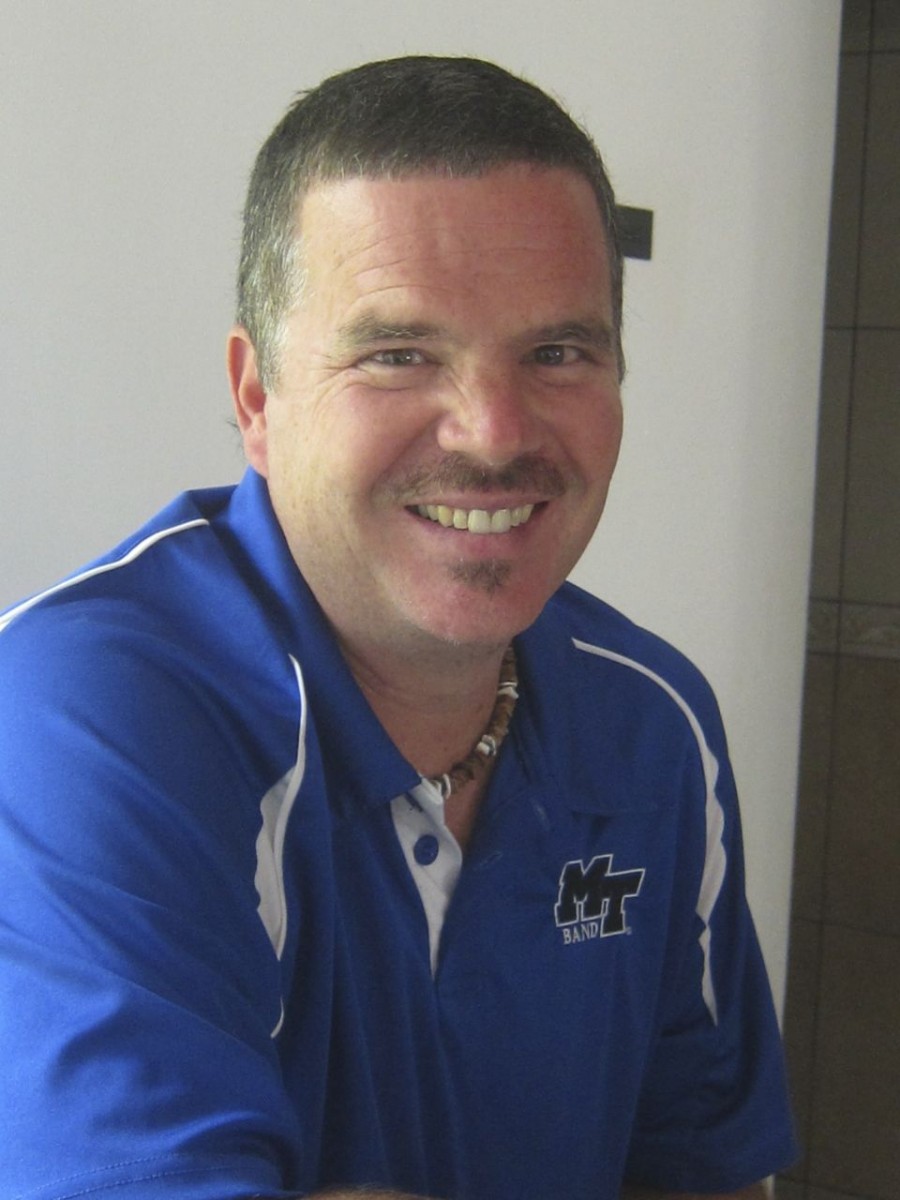
Reed Thomas
He is the founding conductor of the Three Rivers Wind Symphony, a professional group of wind and percussion players from Northeast Indiana and was the Conductor of the Littleton Chamber Winds in Littleton, Colorado from 1997-99. He has been a guest conductor throughout the United States, South Korea, China, Brazil, Panama, Columbia, Costa Rica, Russia, and several European countries.
Dr Thomas is an active conductor and clinician who has received praise and critical acclaim for his artistic interpretations, thorough preparation, and innovative programming from composers such as Nigel Clarke, Kit Turnbull, Jonathan Newman, DJ Sparr, Shafer Mahoney, Peter Fischer, Jamie Simmons, and Robert Bradshaw; and from solo performers such as Peter Sheppard Skaevard, Steve Houghton, Eddie Daniels, Jennifer Gunn, David Cooke, Jonathan Gunn, and She-e Wu for his interpretive conducting. His groups have been invited to perform at venues throughout the United States, China, South Korea, Panama and Costa Rica. Dr Thomas is an avid supporter of new music, commissioning over 60 compositions since 2003. Dr Thomas has four CD albums featuring the MTSU Wind Ensemble on the Naxos and Toccata labels, the two largest classical music labels in the world; the Naxos recordings include the critically acclaimed Angels in the Architecture and Earthrise, while the Toccata Classics labels hosts A Richer Dust and Outrageous Fortune. There are two additional releases pending featuring the music of composers David Maslanka and Peter Fischer. A native of Colorado, Dr Thomas received his Ph.D. in Music with an emphasis in conducting from the University of Minnesota and both his Master’s and Bachelor’s degrees in Music Education from Colorado and was a public school Music Director at two high schools in Utah. Dr Thomas is an active member of several associations including the College Band Directors National Association, the World Association for Symphonic Bands and Ensembles, Pi Kappa Lambda, and Kappa Kappa Psi and is an honorary member of the Costa Rican Band Directors Association, the Korean Band Association, the China Bandmasters Association, and the Asian Pacific Band Directors Association.
MARK HERON (Conductor)
Mark Heron is a Scottish conductor known for dynamic and well-rehearsed performances across an unusually wide range of repertoire, and his expertise as an orchestral trainer.
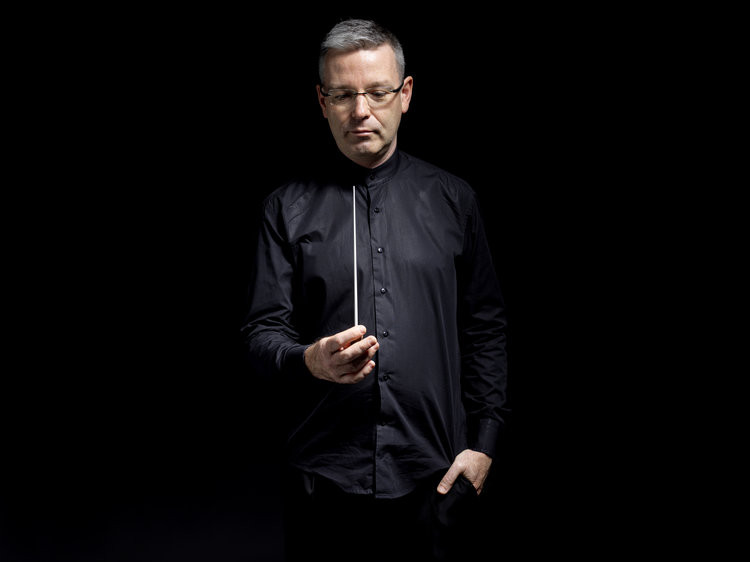 As guest conductor he has appeared with the, BBC Philharmonic, BBC Concert, Philharmonia, Royal Liverpool Philharmonic Orchestra, Royal Scottish National Orchestra, Manchester Camerata, Psappha, Meininger Hofkapelle, Orquesta Sinfónica de la Región de Murcia, Pori Sinfonietta, St Petersburg Festival Orchestra and many more. He is the Music Director of the Nottingham Philharmonic and Professor and Head of Conducting at the Royal Northern College of Music. At the RNCM he works regularly with all of the College’s orchestras and ensembles and runs the world-renowned conducting programmes. Mark is the conductor laureate of the Liverpool Mozart Orchestra and for ten years was Director of Orchestras at the University of Manchester.
Dedicated to working with young musicians, in addition to his role at the RNCM, Mark has conducted ensembles from the Royal Academy of Music, Royal Conservatoire of Scotland, Escola Superior de Música de Lisboa, Tilburg & Maastricht Conservatories, the National Youth Wind Orchestras of Great Britain, Wales and Israel, Slovenian National Youth Orchestra, and many more.
Mark has a keen interest in contemporary music and has given world premieres of many important works. He has collaborated with leading composers such as Kalevi Aho, Sir George Benjamin, Sir Harrison Birtwistle, Unsuk Chin, Tansy Davies, Detlev Glanert, Heiner Goebbels, Anders Hillborg, Giya Kancheli, Magnus Lindberg, Sir James McMillan, Colin Matthews, Christopher Rouse, Kaija Saariaho, and Mark Anthony Turnage. In 2018 he gave the the world premiere of Adam Gorb’s opera The Path to Heaven, and in 2006 the European premiere of American composer Daron Hagen’s opera, Bandanna. He has recorded dozens of CDs with the RNCM Wind Orchestra featuring contemporary wind repertoire on labels such as Chandos, Naxos, NMC, ASC and Polyphonic. Other recording projects have included CDs with the BBC Concert Orchestea and the Royal Liverpool Philharmonic and numerous radio broadcasts with BBC orchestras.
Mark studied at the RSAMD and the RNCM. Following a successful chamber music career and freelance work with many of the UK’s professional symphony orchestras, he undertook conducting studies at the RNCM and in master classes with Neeme & Paavo Järvi, Jorma Panula, and Sir Mark Elder. He worked with Sir Colin Davis and the London Symphony Orchestra on their mentoring programme for young conductors.
Alongside his conducting engagements, Mark is recognised as one of the world’s foremost conducting teachers, and students of his have achieved notable success internationally. As well as his work across all of the RNCM’s renowned conducting programmes, he developed an elite undergraduate conducting programme at the University of Manchester, is a visiting professor to the Royal Air Force and appears often as a guest at conducting courses and master classes all over the world.
JAMES GOURLAY (Conductor)
 James Gourlay is internationally recognised as a soloist and chamber music player of distinction, whose performances of the Vaughan Williams Tuba Concerto, both in London at the Henry Wood Promenade Concerts and in Japan, have been greeted with critical acclaim. He also gave the first British performances of Lacheman’s Harmonia (with the BBC Symphony Orchestra) as well as Penderecki’s Capriccio for solo tuba. World premieres given by him include works by Horovitz, Sparke, Ellerby, Newton and Steptoe. Formerly Principal Tuba with the Zurich Opera, BBC Symphony Orchestra and the City of Birmingham Symphony Orchestra and Musical Director of Brass BandBerner Oberland and the Williams Fairey Band, James Gourlay is also a former Head of the School of Wind and Percussion at the Royal Northen College of Music.
Clarke Rundell is currently Director of Contemporary Music at the Royal Northern College of Music, Manchester. He studied at Northwestern University, Chicago, USA, studying conducting with John Paynter and trombone with Frank Crisafulli of the Chicago Symphony Orchestra, and was subsequently awarded a Junior Fellowship to study conducting with Timothy Reynish at the RNCM. He regularly conducts the Royal Liverpool Philharmonic Orchestra, with whom he made his debut in 1987, as well as the RLPO’s contemporary music group, Ensemble 10:10. Deeply committed to the performance of new music, Clark has given many world and British premieres of works by celebrated international composers. A highly versatile musician, Rundell served fourteen years as Director of Jazz Studies at the Royal Northern College of Music and has performed with artists such as John Dankworth, Bob Brookmeyer, Victor Mendoza, Guy Barker, Julian Arguelles, Ed Thigpen, Cleo Laine, Andy Sheppard, Lew Tabakin and Michael Gibbs.
MARTIN WESTLAKE (Poet)
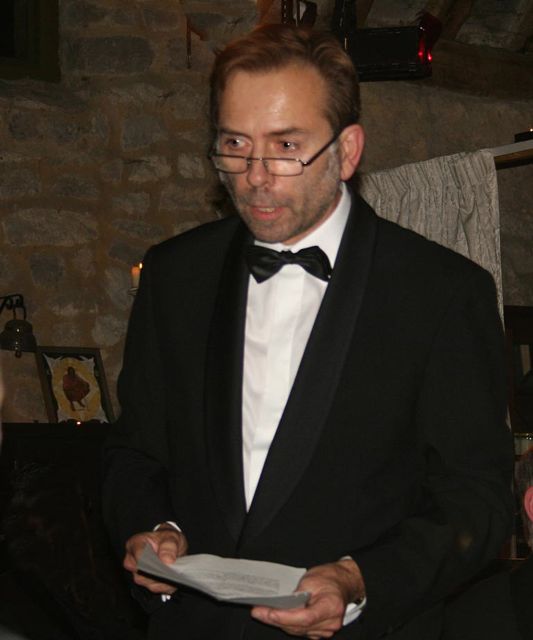 Born in 1957, Martin Westlake is an author and academic. He has studied and worked in the UK, Italy, France and Belgium. His historical novel, Other Than an Aspen Be, is currently on submission.
Production Team:
Producer: Dr Martin Ellerby and Richard Scott / Associate Producer: Kit Turnbull
Recording Engineers: Philip Hardman Chris Thorpe, Richard Scott – Assistant Engineer: Lee Fisher and Oliver Lawson
Recorded at the RNCM Manchester, UK
Polyphonic Reproductions would like to thank:
Brett Baker, Brendan Ball, Dr Martin Ellerby, , James Gourlay, Natalie Grady, Mark Heron, Stan Kitchen, Prof Linda Merrick CBE, Leisha Mofford, Richard Phillips, The Royal Northern College of Music, Timothy Reynish, Clark Rundell, Heidi Sones, Studio Music Company, Reed Thomas, Martin Westlake,
Paul and Sandra Williams, Stella Wilson.
Earthrise (AS8-14-2383) photograph (courtesy of NASA) / Nigel Clarke photograph by Alexandre Badiqué
© 2024 Polyphonic Records
Also Available from Polyphonic Records:
Nigel Clarke Wind Orchestra Music Volume 1
Breaking the Century / Earthrise / Mysteries of the Horizon / Gagarin / King Solomon’s Mines
Nigel Clarke Wind Orchestra Music Volume 2
Tilbury Point / Fanfares and Celebrations / Outrageous Fortune / Storm Surge / Their Finest Hour
Coming Soon!!!
Nigel Clarke Wind Orchestra Music Volume 3
Fields of Remembrance / Heritage Suite / Battles and Chants / Forgotten Heroes